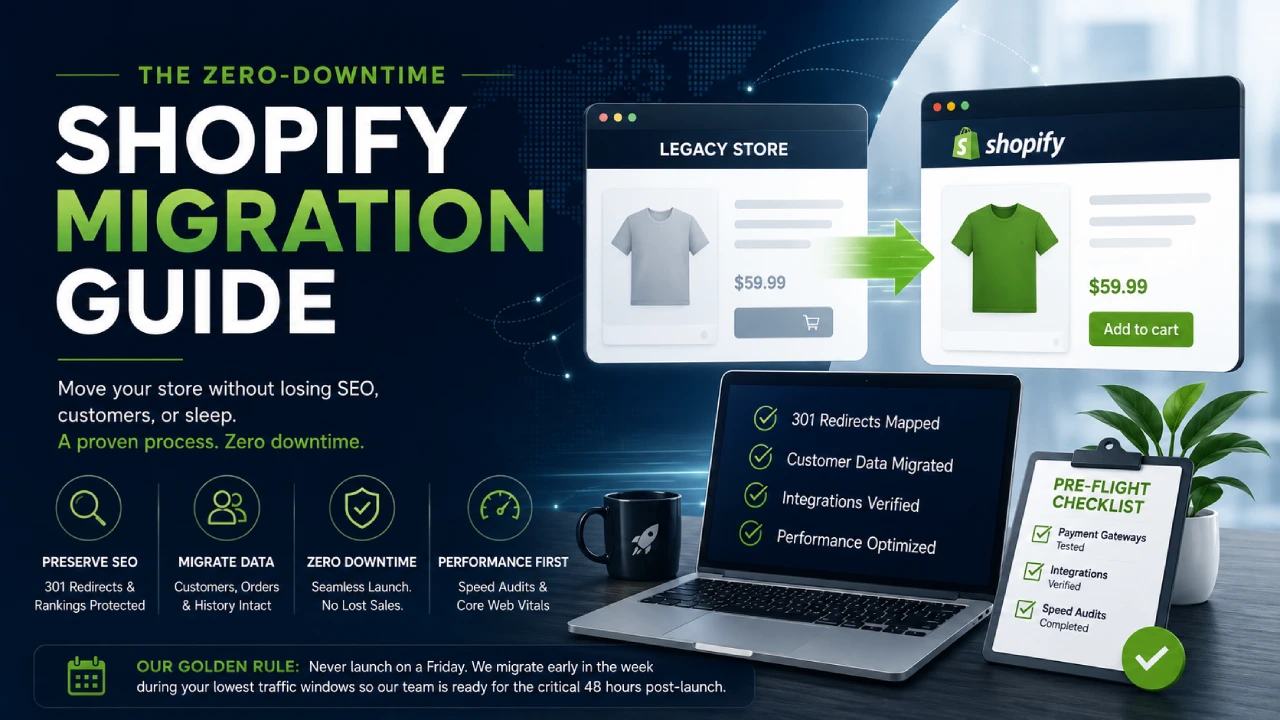
Migrating a successful e-commerce brand to Shopify is a high-stakes operation. If done incorrectly, you risk losing years of SEO authority, disrupting your current customer base, and experiencing expensive downtime.
At Rapid Web, we handle complex migrations without dropping a single order. Here is a look at the methodology we use to ensure a seamless transition.
1. The SEO Preservation Strategy
The biggest fear merchants have during a migration is losing their Google rankings. To prevent this, URL mapping is critical.
- Crawl the Legacy Site: Before touching anything, we run a deep crawl of your existing architecture to capture every indexed URL.
- Map 301 Redirects: We create a comprehensive 1-to-1 redirect map. Every old product URL, category page, and blog post is explicitly routed to its new Shopify equivalent.
- Monitor 404s: Post-launch, we actively monitor Google Search Console to catch and redirect any rogue URLs that slipped through the cracks.
2. Customer and Order Data Transfer
Your returning customers expect their accounts and order history to be intact.
We use automated scripting to export data from your old platform (like Magento or custom architectures) and map it to Shopify's specific CSV and API formats. Because passwords cannot be migrated (due to encryption), we set up automated, branded account activation emails so users can securely set a new password on their first login.
3. The Pre-Flight Checklist
Before we ever flip the DNS switch to make the site live, we go through a rigorous Quality Assurance phase.
Our Golden Rule: Never launch on a Friday. We execute migrations early in the week during your lowest traffic windows, ensuring our entire engineering team is available for the critical 48 hours post-launch.
Final Checks:
- Payment Gateways: Running test transactions in live mode.
- Integrations: Ensuring your ERP, warehouse software, and email marketing tools are talking to Shopify.
- Speed Audits: Verifying that Core Web Vitals meet our strict performance benchmarks.
Ready to Migrate?
If your current platform is holding your business back, it's time for an upgrade. A properly executed migration isn't a cost; it's a foundation for your next stage of growth.